The dance
Maskless and expressive — what makes Mayurbhanj Chhau different
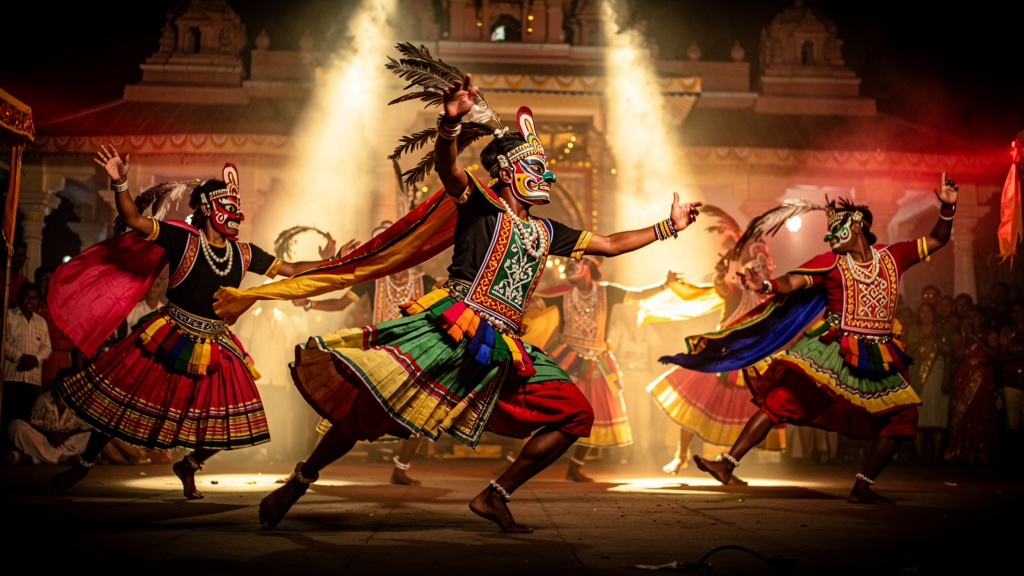
India has three regional Chhau traditions — Mayurbhanj, Seraikella and Purulia. Mayurbhanj is the only one performed without masks. The face becomes the actor’s canvas — every mood is painted in real time, while the footwork, body posture and martial craft do the rest.
Chhau means “a shadow” or “a mask to attract.” In Mayurbhanj the dancers become their own mask. Combined with rigorous footwork, sword work, jumps and spins, the result is a martial dance form that traces lineage to battle rituals, court festivals and, in modern practice, mythological storytelling.
- UNESCO-listed in 2010
- Maskless expression-led style
- Bhanja royal patronage
- Live in Baripada akhadas
Three Chhau forms
How Mayurbhanj Chhau differs from Seraikella & Purulia
| Chhau style | Region | Use of masks | Distinctive traits |
|---|
| Mayurbhanj Chhau | Mayurbhanj, Odisha | Not used — face is exposed | Heavy footwork, sprints, jumps; facial expressions carry character transitions. |
| Seraikella Chhau | West Singhbhum, Jharkhand | Use of ornate masks | Depicts deities and demons; upper-body movement dominates. |
| Purulia Chhau | Purulia, West Bengal | Use of elaborate masks | Theatrical, festival-driven, vibrant colours. |
History
The Bhanja patronage and beyond
Maharaja Sriram Chandra Bhanja Deo — the last ruling king of Mayurbhanj — is one of the most celebrated patrons of the dance. In the late 19th and early 20th centuries, he institutionalised Chhau into the royal court and funded training akhadas around Baripada. His grandson’s lineage continued that legacy through cultural committees and the post-independence state academies.
Today the form is sustained by the Sangeet Natak Akademi, the Odisha state culture department, independent gurus and several national-level dance schools. The Chhau training centre at Baripada is a must-visit for culturally curious travellers.
When to see Chhau
Where to experience it
Chaitra Parab
Every March-April, the night of Chaitra Purnima lights up Baripada with extended Chhau performances — the busiest dance festival of the year. Dancers from across eastern India gather at the town akhadas and the open-air Mahendra ground.
State & national festivals
Through the year, the Odissi Research Centre in Baripada and the Sangeet Natak Akademi’s national Chhau festival bring curated programmes. Watch local listings during your visit.
Practice sessions
Even on non-festival days, you can request a respectful visit to a Chhau akhada. The dancers often rehearse from late afternoon into the evenings. Ask your hotel or guide to arrange a brief visit. Photography during practice is sensitive — always ask.
Chhau workshops for visitors
Several Baripada dance studios offer short workshops (2–5 days) for keen travellers — a chance to learn basic footwork and gestures under a Chhau guru. Available mostly in October-March.
Costume &props
What the dancers wear
The dancer’s costume is as iconic as the form: a richly pleated dhoti-style lower garment, an ornamental belt with hanging ghoongroo bells, a crown or headband, and bright shoulder flaps. Sword, shield, daf, thali and peacock-feather fans handle the props.
Where else to read
Useful references
Information reflects publicly published sources; training schedules and festival dates change annually. Always cross-check locally.